
Key Takeaways
Start here if you want the shortest version of this article.
- ✓ This article is not a BIA theory primer; it is a first-pass selection answer for how the three modules differ and which one your product should start from.
- ✓ For home / commercial scales, watches, wristbands, handhelds or treadmill grips that only contact hands or feet, start with four-electrode BMH05104-2; for handgrip scales, segmental data and professional reports, start with eight-electrode BMH05108 / BMH05109.
- ✓ Accuracy reference: four-electrode solutions correlate about 0.93 with DEXA, while eight-electrode solutions can reach 0.98+; the eight-electrode ceiling is higher, but device structure, electrode contact, posture control and cable routing decide whether that ceiling is realized.
- ✓ Customers do not need BIA impedance front-end or body composition algorithm development experience; after wiring power, the load cell, hand / foot electrodes and the communication interface according to the datasheet, the host can send user data over UART / USB and read body composition outputs.
- ✓ A body composition solution should not be judged only by datasheet parameters or supplier size; also check whether the BIA measurement front end is chip-based and production-ready, whether DEXA validation data exists, and whether certification, SDK/API and debugging support are complete.
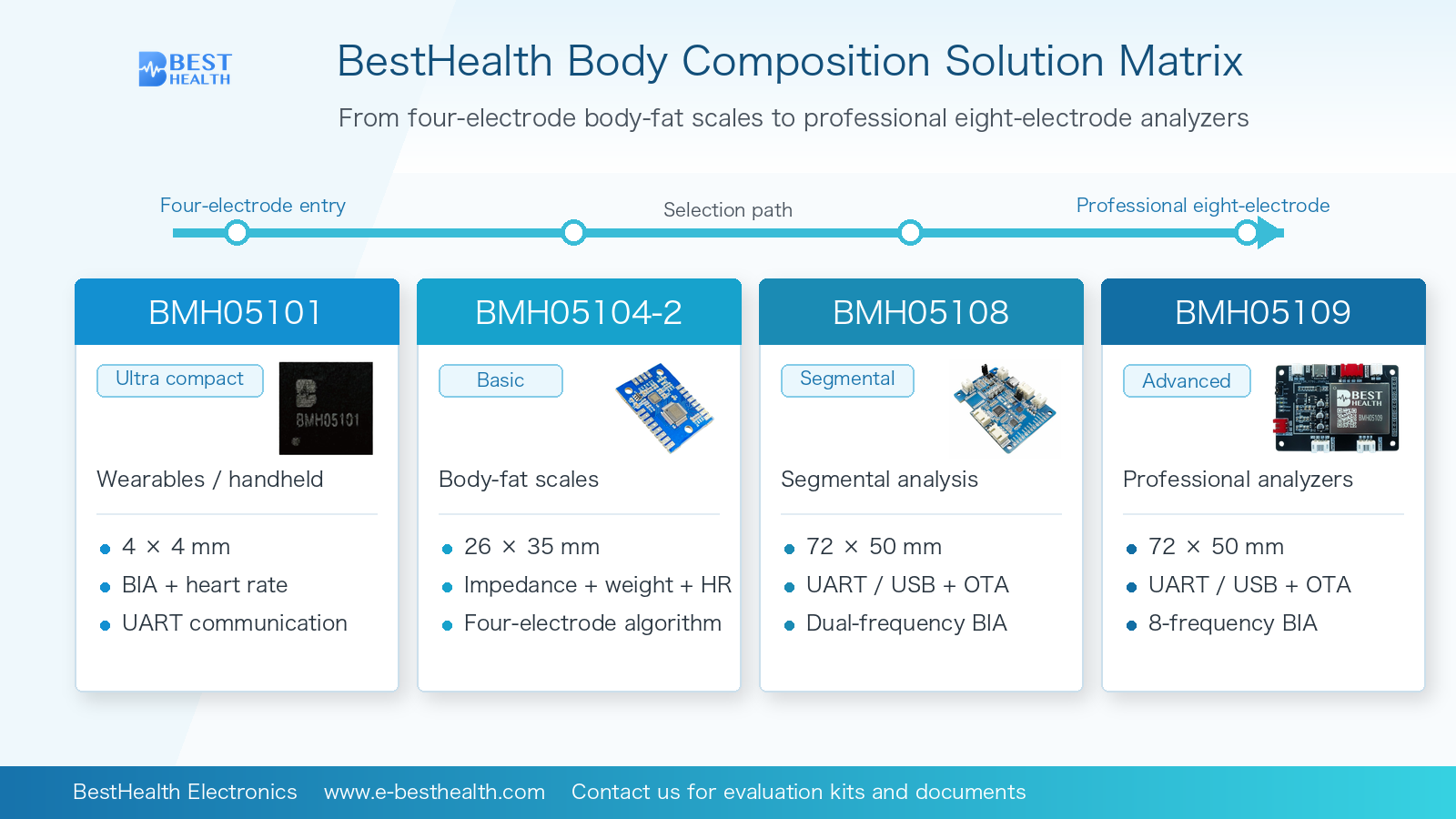
When evaluating BestHealth body composition modules for the first time, teams usually do not need to start with BIA theory. They first ask four practical questions:
- How many body composition modules do you offer?
- What product does each one fit?
- How much accuracy differs between four-electrode and eight-electrode solutions?
- How do we connect the hardware and host controller?
The sections below answer in that order: conclusion first, then the comparison table, then which deeper article hardware, embedded and decision-making teams should read next.
Read it as a selection answer first
This article is the quick-selection entry to the BestHealth body composition article series. The comparisons and recommendations below are directional - the actual supported electrode count, frequency and output metrics are defined by each module’s datasheet and corresponding algorithm documentation. Outputs of ordinary health-management products serve as trend reference; if the finished device is certified / registered under medical device regulations, medical use follows the device’s approved scope and instructions for use.
Answer the four questions first
- Which modules are available? This article compares three body composition modules: BMH05104-2, BMH05108, and BMH05109. They cover four-electrode basic body composition, eight-electrode segmental body composition, and more multi-frequency impedance data.
- What product does each one fit?
- BMH05104-2: fits home / commercial body fat scales, watches, wristbands, handheld devices and treadmill grips that only contact hands or feet.
- BMH05108: fits standing handgrip scales and professional body composition analyzers.
- BMH05109: fits professional products needing more frequency impedance data and finer water assessment.
- How much does accuracy differ? When structure, posture and measurement conditions meet requirements, four-electrode solutions correlate about 0.93 with DEXA, while eight-electrode solutions can reach 0.98+. The eight-electrode ceiling is higher, but the complete product’s electrodes, cables, contact quality and posture control must let the module realize it.
- How do we integrate it? Customers do not need prior BIA impedance front-end design, body composition algorithm modeling or parameter-calibration experience. Wire power, the load cell, hand / foot electrodes and the communication interface according to the datasheet, send age, sex and height over UART / USB, and read body composition outputs. This shortens integration time, accelerates production ramp-up, and helps the finished device realize module performance more consistently.
The three modules at a glance
| Dimension | BMH05104-2 | BMH05108 | BMH05109 |
|---|---|---|---|
| Electrode scheme | Four-electrode (two legs or two arms) | Eight-electrode (segmental limbs) | Eight-electrode (segmental limbs) |
| Frequency | 50kHz single | Dual-frequency | 8 frequencies |
| Output range | Whole-body composition | Whole-body + limb + trunk segments | Whole-body + limb + trunk segments, phase angle, finer water assessment |
| Body composition parameters | 25 | 58 | 58 |
| Accuracy reference (vs DEXA) | Correlation ~0.93 | Up to 0.98+ | Up to 0.98+ |
| Power range | 3.3~6V | 5~12V | 5~12V |
| Communication | UART | UART / USB | UART / USB |
| Firmware upgrade (OTA) | — | Wired / wireless | Wired |
| Solder-free assembly | — | Yes | Yes |
| ESD / power immunity | ★★★★☆ / ★★★☆☆ | ★★★★★ / ★★★★★ | ★★★★★ / ★★★★★ |
| Typical form factor | Body fat scale, band, watch, handheld / treadmill grip | Standing-grip scale, professional body composition analyzer | Professional analyzers needing more multi-frequency impedance data |
Read the table this way:
- If the product only needs basic whole-body composition, start with BMH05104-2.
- If it needs segmental limbs, left-right balance and professional reports, start with BMH05108.
- If it also needs more multi-frequency impedance data, phase angle and finer water assessment, look at BMH05109.
Three typical scenarios - find yours
- Home / commercial body fat scales, or hand-contact-only wearables and handhelds - you only need whole-body fat, water and muscle, with low cost and low posture sensitivity. -> Four-electrode BMH05104-2.
- Standing scales with grips, professional body composition analyzers - you need segmental limb fat / muscle, left-right balance and professional reports. -> Eight-electrode dual-frequency BMH05108.
- Professional products needing more frequencies, phase angle, intra/extracellular water or water-distribution assessment. -> Eight-electrode 8-frequency BMH05109.
When unsure, confirm two things first
Which metrics the display must show, and whether the user touches hands or feet (or both). Once these two are fixed, electrode count and frequency are largely determined - don’t start from “how many electrodes,” work backward from form factor and output needs.
How to integrate it into the finished device
These body composition modules are not just bare impedance chips. Impedance measurement, weight measurement and body composition algorithms are handled on the module side. Finished-device integration focuses on connection, communication and validation:
- Hardware connection: wire power, the load cell, hand / foot electrodes and the communication interface according to the datasheet. Four-electrode products only need the corresponding hand or foot contact path; eight-electrode products need the left hand, right hand, left foot and right foot electrode structures and cable paths designed together.
- Host communication: BMH05104-2 uses UART; BMH05108 / BMH05109 support UART / USB. The host controller or PC tool writes user data such as age, sex and height according to the protocol, then reads fat, water, muscle, segmental metrics and other outputs.
- Complete-product validation: the module’s ceiling still depends on structure, electrode material / size / spacing, cable routing, posture control and weight calibration. For hardware design, read Electrode and Cable Hardware Design; for bring-up issues, read Impedance Troubleshooting.
What makes a body composition solution worth choosing
Quick selection answers which module to start from. During supplier shortlisting, the more important question is whether the BIA solution can scale to production and realize its performance in the finished device. A strong solution should not be judged only by datasheet parameters, supplier size or one impedance-chip metric; the measurement front end, algorithm, validation data and engineering support need to form a complete system:
- Whether the BIA measurement front end is chip-based and production-ready - the impedance front end determines consistency, noise immunity, calibration complexity and long-term cost. BestHealth is a chip-design company, and the BIA measurement front end is implemented with a self-designed IC rather than assembled from multiple discrete components. This helps the module build advantages in batch consistency, cost control and performance stability.
- Whether validation data is benchmarked against the DEXA gold standard - is there published, same-period correlation data against tertiary-hospital DEXA, not just a comparison against another BIA device.
- Whether the algorithm and interface are easy to integrate - is the body composition algorithm built in, are the output metrics complete, and is host integration simple (feed user data over standard serial / USB and read the results).
- Whether finished-device design support is available - can you get guidance on electrode size and material, spacing, routing, and the separation of excitation and sensing; these directly determine whether the finished device realizes the module’s accuracy.
- Whether certification and project experience support implementation - can the supplier support Class II medical device registration of the finished device, providing the corresponding test data, technical support and even named cases.
- Whether technical response is fast enough - when impedance anomalies or low correlation appear during bring-up, can the problem be located quickly.
If the underlying measurement front end is assembled from discrete components, production consistency, calibration cost, noise immunity and long-term supply cost all need careful evaluation. BestHealth provides a complete solution from its self-designed BIA measurement front-end IC, module hardware and built-in algorithms to validation data and engineering support, helping customers integrate faster, ramp production more smoothly and realize finished-device performance.
What to read next
Pick a reading path by your role:
- Decision makers / marketing / quality: Validation Results -> DEXA Comparison Methodology -> BIA Principles and Selection
- Hardware / mechanical engineers: BIA Principles and Selection -> Electrode and Cable Hardware Design -> Impedance Troubleshooting
- Software / embedded engineers: Algorithm Selection and Integration -> Impedance Troubleshooting
For full datasheets, validation data, or selection advice tailored to your form factor, please contact us. Related modules: BMH05104-2, BMH05108, BMH05109.
Related Articles
Continue with articles covering adjacent engineering topics and implementation details.
Body Composition Principles
BIA Body Composition Measurement Principles and Four / Eight-Electrode Selection
Starting from the conductivity principle, this guide explains how BIA measures body composition, what the resistance and reactance inside impedance represent, why a four-electrode setup is required instead of two, and the difference between single and multiple frequencies. It then compares four-electrode (two-leg / two-arm) and eight-electrode (segmental) approaches by measurement path, output items, accuracy, cost, and product form, to help you pick the right approach and module for scales, wearables, and professional analyzers.
June 15, 2026
Solution Integration
Body Composition Algorithm Selection and Integration Guide
For manufacturers building body-fat scales, analyzers, and wearables on the BMH05104-2 / BMH05108 / BMH05109 modules, this guide explains the selection boundary of BestHealth module built-in body composition algorithms, the impedance location, frequency, electrodes, and output items of TwoLegs / TwoArms / Body120 / Body270 / Body810, and where optional Web API / Android / iOS, mini-programs, customer-platform adaptation, and paid custom algorithms fit.
June 15, 2026
Solution Evaluation
Validation Results - BestHealth Body Composition vs Hospital DEXA and Professional BIA Devices
For manufacturers evaluating the BestHealth BMH05104-2 / BMH05108 / BMH05109 body composition modules and looking for accuracy-validation data, this article publishes same-period comparison results from a 100-person cohort: against two tertiary-hospital DEXA references (the gold standard), muscle mass correlation is 0.978-0.983; against marketed professional BIA comparison devices, fat-free mass, skeletal muscle mass, fat mass and body-fat percentage correlate 0.978-0.995; dual-hospital DEXA cross-validation provides an additional reliability reference.
June 25, 2026
BestHealth
Need technical support for your next project?
Share your application scenario and target requirements. Our team can help with device selection and solution planning.